
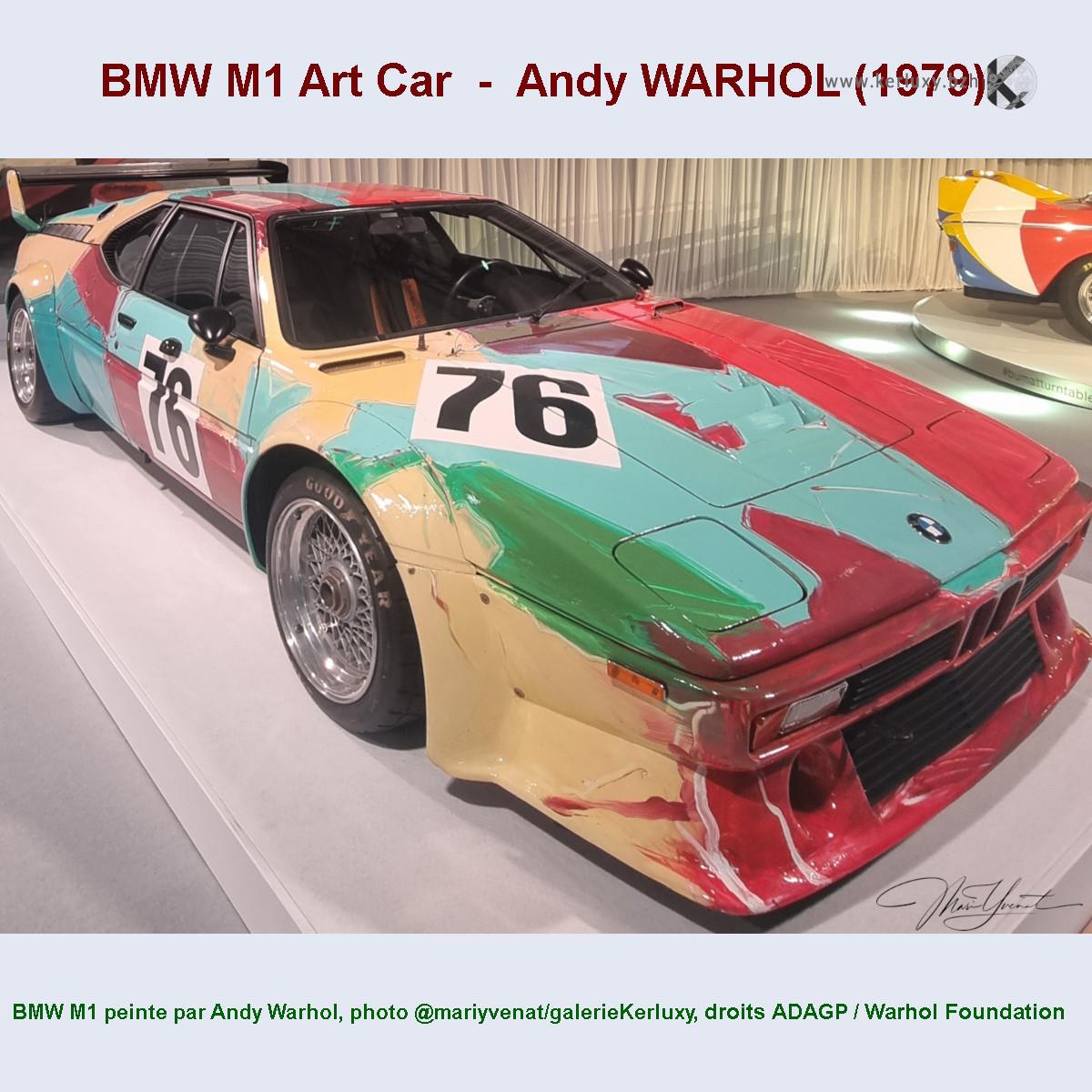
The BMW M1 by Andy WARHOL
"Reworked Icons" Art Collection - II
Andy Warhol and the BMW M1 Art Cart: when speed becomes an image
The BMW M1 Art Car, created in 1979 by Andy Warhol, holds a unique place in the history of contemporary art. Commissioned as part of a program initiated by BMW, it is one of a series of projects entrusted to leading artists, who were invited to transform race cars into canvases for free expression. In this context, the automobile ceases to be merely a technical object: it becomes a medium for visual experimentation, engaged in a reflection on speed, image, and modern culture.
Warhol took a radically different approach from that of his contemporaries in the project. Where some artists create preparatory sketches or compositions designed for three-dimensional space, he chose immediacy. He painted directly onto the body of the BMW M1, without a detailed plan, in a swift, almost instinctive gesture. In less than half an hour, nearly six kilograms of paint were applied directly to the surface, in a direct engagement with the material, without any attempt at adjustment or retouching.
This choice is not trivial: it transforms the artistic intervention into a performance, where the tempo of the gesture merges with that of mechanical speed. The car itself, six cylinders, 471 horsepower, 310 km/h for about a ton, imposes a technical framework that extends this logic of intensity and constraint.
The result retains this raw energy. The colors do not settle; they flow. They seem to extend the very movement of the car, as if the paint were not meant to be revealed, but to convey a dynamic. The work does not seek a finished look, but rather tension. It reveals an intermediate state between appearance and disappearance, between object and perception.
This project takes on a special dimension when one considers that the BMW M1 is a race car designed for pure performance, endurance, and speed, and that it competed in the 24 Hours of Le Mans. It is not merely a mobile sculpture or an exhibition piece: it entered the real race, confronting mechanics, the night, extreme speed, and wear and tear. Few works of the 20th century can claim such a direct confrontation with reality. This interplay between art and performance lends the piece a singular intensity, where the image does not merely represent speed bu experiences it.
In this work, Warhol explores the themes that run through his entire body of work. From his early pieces to his iconic series featuring Marilyn Monroe and consumer objects, he examines how images shape our perception of the World. Repetition, saturation, and the circulation of motifs are never merely formal techniques: they constitute a language. Here, this language is applied to an industrial object, transformed into a surface of visual appearance.
Color plays a central role as it fragments the viewer's perception of the object. The solid blocks of green, yellow, red and blue do not depict anything. They do not cover the machine to erase it, but to visually reconfigure it. The car thus becomes an unstable visual field, where no single viewpoint is definitively established. The viewer is compelled to move around the work, mentally reconstructing what they perceive.
This logic points to a constant in Warhol's work: the transformation of the everyday into a critical image. The artist does not seek to rank the objects of the world, but to reveal their circulation within a space saturated with signs. The car, a symbol of modernity, speed, and industrial power, becomes here a medium for reflection on contemporary visual culture.
Photographed at the 2026 Rétromobile show, the BMW M1 Art Car appears in a context that extends its meaning. It is not isolated: it is surrounded by other vehicles, posters, booths, and elements that highlight its place within a world of presentation and staging. This setting reinforces its interpretation: the work is not merely an object; it is also an image within a system of images.
For both the collector and the viewer, this piece offers a direct experience. It is not merely something to be looked at: it demands a physical presence, movement, and time. It resists immediate interpretation, and it is precisely in this resistance that its strength lies.
Mari Yvenat
Visit the Andy Warhol exhibition at SFMoMA
Andy Warhol: the Enigma of the visible
©mariyvenat