
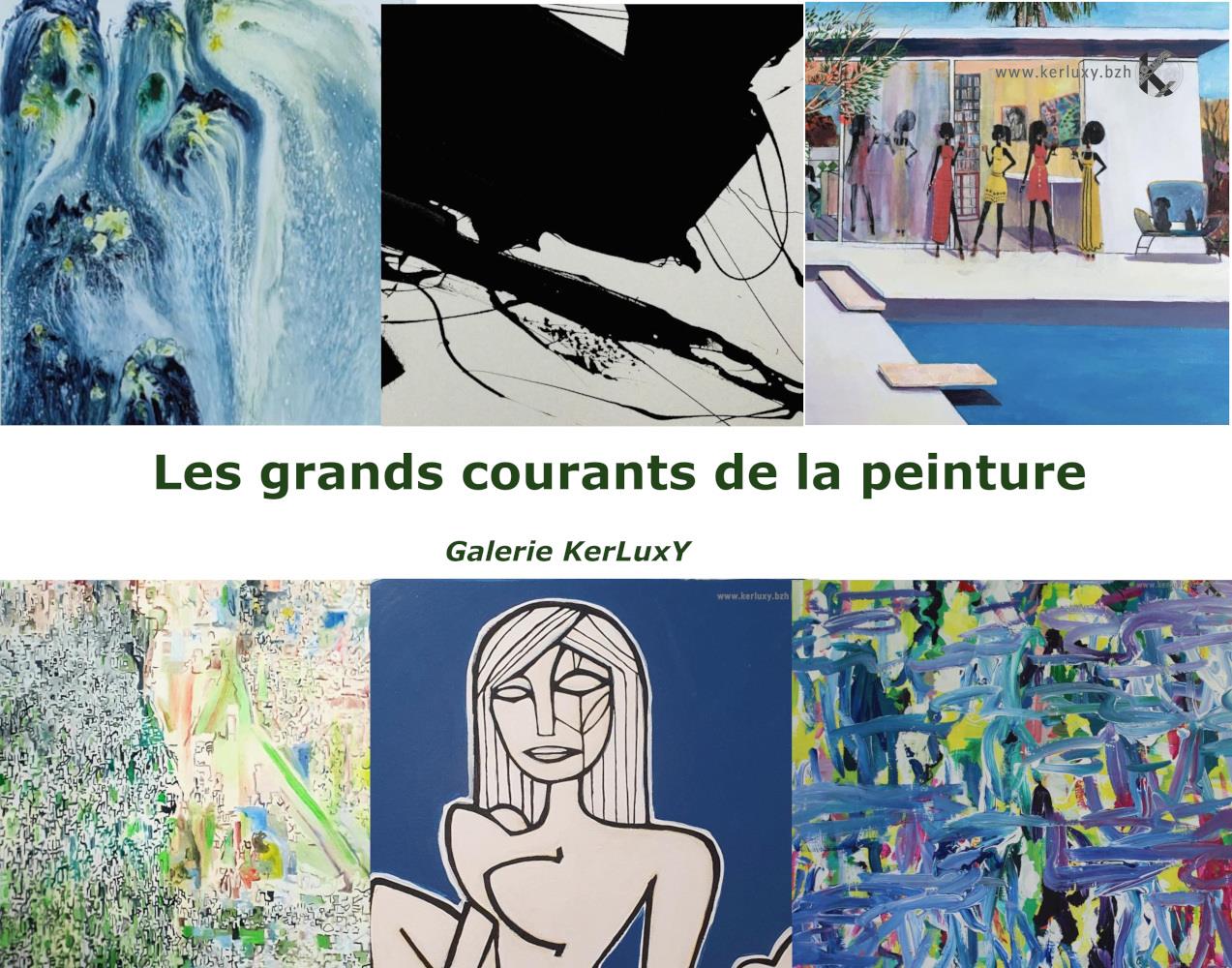
Major movements in painting, from Gothic to Pop Art
Behind every painting lies a way of seeing the world. Impressionism captures light, abstraction plays with texture and emotion, and Pop Art reinterprets everyday imagery. This guide introduces the major movements in painting, helping you better understand the artworks and refine your eye.
 UNDERSTANDING THE MAJOR MOVEMENTS IN PAINTING
Early XIIIth century / XIVth century – Gothic Painting
We find Gothic painting in illuminations, frescoes and altarpieces of churches or the first individual portraits of great people. The first portrait is that of King John the Good around 1360. Iti is also the birth of Secular painting.
Some famous painters:
. Ambrogio Lorenzetti – « Madonna di Vico l’Abate, 1319 » ;
. Simone Martini – « L’Annonciation », « Maestà, 1315 ».
The 15th century – The Dawn of the Renaissance, also known as the « First Renaissance »
The cradle of the Renaissance is located in Florence. Feudal society gave way to a new, more open society. Painting underwent a prodigious expansion and imposed itself as an art form. The artists of the Renaissance sought to express human life and reality in their works. Atmosphere, perspective and form are their essential concerns.
Some famous painters:
. Masaccio - « Saint Pierre distribuant des aumônes aux pauvres » ;
. Mantegna - « Le Christ mort ».
End of 15th century /16th century - Affirmation of the Renaissance, still called « classical renaissance »
This century is that of the giants of Art. In Rome: Michelangelo, Raphael… In Venice: Titian, Veronese… In Lombardy, Leonardo da Vinci. The Renaissance reached during this century its full maturity of expression. Artists in search of beauty were inspired by the ancient world while using their knowledge and new techniques such as linear perspective. New painting subjects, such as landscape and nudes, appeared.
Some famours painters:
. Sandro Botticelli – « La Vierge à l’enfant, 1467 », « La naissance de Vénus, 1484-1485 » ;
. Léonard de Vinci - « La Cène, 1495-1498 », « La Joconde, 1503-1506 » ;
. Raphaël - « Les Trois Grâces, 1504-1505 », « Chambre de la Signature, 1508 » ;
. Michel-Ange – « Fresques de la Chapelle Sixtine, 1508-1512 », « Le Jugement dernier, 1536-1541 » ;
. Titien – « La Vénus d’Urbin, 1538 », « Vénus au miroir, 1554-1555 ».
Painters of the KerLuxY Art Gallery:
. Tristan creates vaporous atmospheres in his oil paintings. This pictorial technique of « Sfumato » was invented by Leonardo da Vinci. His works are proposed on the site KerLuxY: « The Dragon’s golds »...
The 16th and 17th centuries - The Prestige of the Kings of France
From François I to Charles IX, each king left a strong artistic imprint, rich in refined works.
Mannerism 1520-1580
Inspired by their classical predecessors, Mannerist painters blurred the reference points in terms of space and time. In this incoherence, the bodies are also deformed, the musculature very accentuated, the effect of movement sought. The female nude is animated by the serpentine line, signature of mannerism. The painter of this movement is in search of his singularity to establish a recognition.
Some famours painters:
. Paolo Véronèse – « La tentation de Saint Antoine, 1551 », « les Noces de Cana, 1563 » ;
. Pontormo – « Joseph en Egypte, 1518 ».
è MANNERIST PAINTERS FROM THE SCHOOL OF FONTAINEBLEAU:
The first School of Fontainebleau 1526-1570
The French Court moved to Fontainebleau. François I (reign 1515-1547) invited Italian artists to embellish his Palace. Mythological scenes and nudes were sources of inspiration for Mannerist artists. The Great Gallery is covered with the animal emblem of the king, the salamander. Large libertine frescoes adorn the rooms.
Some famous painters:
. Rosso Fiorentino – « Le Sacrifice, 1534-1539 » ;
. Le Primatice (Francesco Primaticcio) - « Apollon et les Muses au Parnasse » ;
. Jean Clouet - « François 1er, vers 1530 » ;
. Antoine Caron – « Diane Chasseresse, vers 1550 ».
The second School of Fontainebleau 1594-1617
In France, under the reign of King Henry IV (1594-1610) and the regency of Marie de Medicis (1610-1617), royal building sites were resumed; the Palace of Fontainebleau was thus completed. The new masters of this movement were French and Flemish painters. The subject of predilection of the Mannerist artists will be the romantic scenes in particular.
Some famous painters:
. Ambroise Dubois – « Portrait de Marie de Médicis en Minerve » ;
. Toussaint Dubreuil – « Henri IV en Hercule, 1600 », « La montée au Calvaire, fin XVIe ».
The 17th century -Caravaggio
An innovator, Caravaggio (1571-1610) structured his works through the effects of light and shadow. A
Some famous painters:
. Le Caravage – « Le jeune Bacchus malade, 1591 », « Saint Matthieu et l’Ange, v. 1602 » ;
. Georges de La Tour – « Les Mangeurs de pois, 1622-1625 », « La Rixe des musiciens, 1625-1627 » ;
. Rembrandt – « Le Reniement de Saint Pierre, 1660 ».
The 17th and 18th centuries - The Baroque
Born in Italy during the seventeenth century, this movement had for precursors Michelangelo, Tintoretto and Correggio. During this period realism was king. Painting reached a degree of perfection never surpassed. Rembrandt made an exceptional discovery: chiaroscuro. This new technique allowed painters to take a gigantic step towards the conquest of atmosphere and ambiance. It was the time of the great paintings for palaces, life-size portraits and vast compositions full of life and movement.
Some famous painters:
. Rembrandt – « La ronde de nuit, 1642 », « Le Syndic de la guilde des drapiers, 1662 » ;
. Diego Vélasquez – « Portrait de chevalier, 1623 ».
The 17th century - The Classicism (1650-1750)
With Classicism, the French works find clarity and rigor, the scene is ordered and finished in space. They were inspired by ancient art and the Renaissance, far from the codes of Mannerism and Baroque. The drawing and its regular lines serve noble or complex themes. The Court of Versailles displayed its power by investing massively in Art; Charles Le Brun was the first painter of King Louis XIV, in charge of the decoration of the Louvre, the castles of Vaux-le-Vicomte and Versailles.
Some famous painters:
. Nicolas Poussin – « Les Bergers d’Arcadie, vers 1640 » ;
. Charles le Brun – « Entrée d’Alexandre dans Babylone, 1664 » ;
. Louis Le Nain – « Le repas des paysans, 1645 », « La Forge, 1642 » ;
. Georges de la Tour – « Le Tricheur à l’as de carreau, 1636 ».
The 18th century - The Rococo (1715-1780)
France took the place of Italy as a pole of artistic attraction with reference to the end of the reign of Louis XIV and then under the reign of Louis XV, their palaces, their decor and their way of life. This was the time of bucolic subjects, evaporated women and « licked » painting. The beauty and complexity of the Rococo works produced gave them an indisputable value from a technical point of view. The movement disappeared at the dawn of the French Revolution in 1789.
Some famous painters:
. Antoine Watteau – « Fêtes vénitiennes, 1718-1719 » ;
. Jean-Honoré Fragonard – « Les Baigneuses, 1765 », « Les Hasards heureux de l’escarpolette, 1767 » ;
. François Boucher – « l’Odalisque blonde, 1751 », « Pan et Syrinx, 1759 ».
Late 18th century - Neo-Classicism(1760-1800)
Alongside Goya’s work, art underwent a profound transformation due to major historical events. The spirit of the French Revolution invaded the field of art, which was now open to all. The Empire then precipitated a return to classicism. The Neo-Classical style follows uncompromising rules of composition applied without any concession. In the confusion, something is preparing for painting: on the one hand the return to classical antiquity, on the other hand the birth of romanticism. The colors undergo a sensitive revolution that foreshadows the next century.
Some famous painters:
. Jacques-Louis David – « La mort de Marat, 1793 » ;
. Jean-Auguste-Dominique Ingres – « L’apothéose d’Homère, 1827 ».
End of the 18th century - Romanticism (1795-1850)
With Romanticism, feelings are expressed with passion and exaltation. The themes of predilection are fear, violence, death, freedom, imagination and dreams.
Some famous painters:
. Eugène Delacroix – « Scènes des massacres de Scio, 1824 », « La mort de Sardanapale, 1828 », « La Liberté guidant le peuple, 1830 » ;
. Théodore Géricault - « Le Radeau de la Méduse, 1819 » ;
. Francisco de Goya - « Tres de Mayo, 1814 » ;
. Caspar David Friedrich - « Le Voyageur contemplant une mer de nuages, 1818 ».
1860- Birth of Impressionism
The term « Impressionism » refers to the title of a painting by Monet, « Impression, Sunrise ».
The meaning and purpose of Impressionism was to substitute a new conception of light and life for the dark colors and solid forms that realists lent to things. Artists left their studios to paint outdoors; the major theme was the landscape.
Some famous painters:
. Claude Monet – « Coquelicots, 1873 » : « Nymphéas, paysage d’eau, 1905 et 1908 » ;
. Edgar Degas – « La classe de danse, 1873-1875 » ;
. Gustave Caillebotte – « Les Raboteurs de parquet, 1875 » ;
. Auguste Renoir « Bal du Moulin de la Galette, 1876 » ;
. Vincent van Gogh – « Iris, 1889 ».
Painters of the KerLuxY Art Gallery:
. Daniel Paugam exhibits impressionist style paintings on KerluxY Art Gallery: « Les Nénuphars fleuris », «Water lilies of silence n°1/3», « Water lilies of silence n°2/3 », « Water lilies of silence n°3/3 », « Reflets de roses », « Reflets jaunes », « Funny water lilies n°1/3 », « Funny water lilies n°2/3 », « Funny water lilies n°3/3 », « Reflets de roses », « Reflets jaunes ».
End of the 19th century – Reaction to Impressionism
The avant-garde paintings were looking for new ways. New groups and styles followed the eternal movement forward, always in search of concepts and forms to discover. Thus were born:
The NATURALIST painters
After a romantic preamble, the art of this time gradually discovers its way. The century was thus born under the sign of romanticism. The initiative belongs to the English. A new technique appeared: watercolor. Art becomes more democratic and we can see “the man in the street” making his own artistic attempts.
Some famous painters:
. William Turner – « Paysage avec une rivière et une baie dans le lointain, 1835 » ; « Landscape with a river and a bay in the background, 1845 » ;
. John Constable – « Paysage avec cottages, 1809-1810 », « Le champ de blé, 1816 ».
The SYMBOLIST painters – 1870/1914
Symbolist painters reject the standards dictated by academia, realism and naturalism. Melancholy, anguish, pessimism, darkness, fear, pain and death dominate their works. Among them, the group of Nabis artists met at Pont-Aven in Brittany.
Some famous painters:
. Paul Gauguin - « Le Christ Jaune, 1989 » ;
. Pierre Puvis de Chavannes – « L’Espérance, 1872 », « Le Rêve, 1883 » ;
. Gustave Moreau - « Salomé dansant devant Hérode, 1876 » ;
. Edvard Munch - « Le cri, 1893 », « Anxiété, 1894 ».
The SYNTHETIC painters (1886-1888)
The artists follow the style of the Pont-Aven School (go to the essential with flat areas of bright colors without perspectives and the partitioning of the plans).
Some famous painters:
. Paul Gauguin – « La vision après le sermon, 1888 », « La belle Angèle, 1889 » ;
. Paul Sérusier – « Le Talisman, 1888 ».
The REALIST painters– second half of the 19th century
The realist movement sounded the death knell of romanticism, as evidenced by the canvas painted by Gustave Courbet in 1849 « A funeral in Ornans ». The subject of predilection is none other than scenes imprinted with real life without artifice.
Some famous painters:
. Gustave Courbet - « L’homme à la pipe, 1844 », « Un enterrement à Ornans, 1849 », « L’Origine du Monde, 1866 » ;
. Camille Corot - « La femme à la perle, 1869 », « La lecture interrompue, 1870 ».
The MODERNIST painters (1870-1950)
The modernist movement took root at the height of the industrial revolution. The precursors eager for freedom wished to break with tradition. The work is simplified, stripped of decorative elements, pure colors contrast.
Some famous painters:
. Henri de Toulouse-Lautrec – « La Goulue et sa sœur au Moulin Rouge, 1892 » ;
. Edouard Manet – « Le déjeuner sur l’herbe, 1863 ».
1880 – Pointillism – late 19th Century
A painting technique invented by Georges Seurat, Pointillism is a movement easily recognized by its use of unmixed colors. The canvas is composed of small, juxtaposed dots of pure paint. As the viewer steps back from the work, the eye blends the colors and reconstructs the scene.
Some famous painters:
. Georges Seurat – « Le jardinier, 1882 », « La Seine à Courbevoie, 1885 » ;
. Paul Signac – « Concarneau opus 221 adagio, 1891 », « La voile verte, 1904 » ;
. Camille Pissarro – « Kew Greens, 1892 ».
1904 - Expressionism – Early 20th Century
The Expressionist movement emerged in Northern Europe in the early 20th Century. With the rise of photography, painting no longer held the exclusive role of reproducing reality. Expressionist art thus emerged, distorting reality to evoke an emotional response. A sense of anguish is evident in some of these works.
Some famous painters:
. Edvard Munch - « Le Cri, 1893 » ;
. Bernard Buffet – « Le Clown bleu, 1955 » ;
. Vassily Kandinsky – « Fugue, 1914 ».
The painters of the KerLuxY Gallery:
. M-L Le Campion presents expressionist-style canvases on the KerluxY Gallery:
« 2022-5 Diptyque I et II », « Mirage », « Le Plongeon », « Nager en eaux troubles », « Petit poisson deviendra grand », « 2019-5 », « 2019-6 », « Une histoire de couleurs », « 2022-6 », « Abysses », « Une bouffée d’air
marin », « Dans les profondeurs » ;
. Marief presents expressionist-style canvases entitled "Fleurs d'eau" ;
. Eric Pichon draws inspiration from David Hockney for his expressionist painting « Cocktail by the Pool ».
1905 – Fauvism – Early 20th Century
The Fauvist movement of the early 20th Century is rooted in instinct. Color saturates the space like fireworks. Artists abandon rational perspective and lay down broad, flat areas of color where the simplification of forms reigns supreme. Fauvism also sees the emergence of self-taught painters.
Some famous painters:
. Henri Matisse - « La Raie verte, 1905 » ;
. André Derain - « La femme en chemise, 1906 » ;
. Kees Van Dongen - « La Danseuse indienne, 1907 », « Le Tango de l’Archange, 1935 ».
1908 – Cubism – Early 20th Century
The Cubist movement emerged in the early 20th Century, with Paul Cézanne as its precusor; he moved away from traditional perspectives and shifted planes. Pablo Picasso and George Braque founded Cubism, influenced by primitive art. The works are fragmented, with planes superimposed on the same canvas. The image is broken dawn into a multitude of geometric shapes, presenting a 3D view to the eye. In Picasso's work, the face is displayed simultaneously from the front and in profile.
Some famous painters:
. Pablo Picasso – « Guernica, 1937 », « Femme qui pleure, 1937 », « Homme à la sucette, 1938 », « Dora Maar, 1939 »;
. Georges Braque - « Broc et violon, 1909-1910 », « La musicienne, 1918 »;
. Robert Delaunay - « La Tour Eiffel, 1911 », « La Ville de Paris, 1912 ».
The painters of the KerLuxY Gallery:
. Daniel Paugam presents « A little dance before milking » a burlesque scene from a rustic fantasy ;
. Alexandre Musso pays tribute to Cubism in the canvases « Demeter » et « Venus » ;
. Twoodje presents « The blue portrait », a deconstructured and destructured portrait evoking the distinctive features of the Picasso style.
1911 – Metaphysical painting
De Chirico was the precursor to this surrealist art. In this painting, the atmosphere takes on extraordinary power, a mystery radiating from the setting, the dramatic interplay of light and shadow, and a perspective exaggerated to an unreal degree. The painting seems to have emerged from a world of incubi and draws inspiration from inhuman subjects. Its composition is both theatrical and architectural, yet distorted in an unreal way.
Some famous painters:
. Giorgio De Chirico – « Hector et Andromaque, 1918 » ;
. Carlo Carra – « La chambre enchantée, 1917 » ;
. Giorgio Morandi – « Nature morte, 1920 ».
1913 - Abstract Art
The Abstract movement emerged around 1913 when the Russian painter Vassily Kandinsky claimed to have painted the first abstract subject. The artistic composition dispenses with all visual reality. On the canvas, geometric or curved shapes sit alongside colors, or sometimes not. The black-and-white style is widely represented. Abstract art canvases lend themselves to multiple interpretations; it is up to each individual to decipher the imaginary.
Some famous painters:
. Vassily Kandinsky - « Cossaks, 1910-11 », « Swinging, 1925 ».
The painters of the KerLuxY Gallery:
. Cha Sun is a Fine Art graduate who presents abstract canvases: « chalim 2 », « chalim 3 », « chalim 4 », « chalim 5 »;
. Daniel Paugam presents abstract paintings: « Les cités tubulaires » Abstrait noir sur blanc aux traits droits et arrondis, « Paysage lointain » Abstrait à-plats larges noir & blanc, « Les 2 oiseaux » Abstrait à-plats larges, « La Grotte Bleue » sorte de monde intérieur, « Animal courant » Abstrait enlevé, « Tao Tse Toung n°2 », « Animal à grandes ailes » Abstrait brillant avec dégradés, « Œil-Pétale », dégradés de rouges dessinant un œil, « L’Algue-Eventail » dégradés de roses jusqu’au lie-de-vin, « Le Demi-Papillon » dégradés d’ocres et de bleus, « Le Coquelicot » dégradés en forme de fleur ouverte, « Ubister jaune » Mélanges abstraits brillants, « Le Passage » bord de mer abstrait, « Réflexion dans un fauteuil » Abstrait enlevé, « Animal volant » Abstrait à-plat large, « Caresse », « Animal Sauvage » ;
. Twoodje presents abstrac deconstrutured paintings and drawings. From colorful interlacing patterns, a portrait with varied expressions emerges. Discover: « Les quatre amis », « Borgne à l’oreille bleue », « Portrait bleu », Le jeu des 7 erreurs », « Les 2 Catalans », « Visage à la joue blanche », « L’invisible », « Les Don Quichotte d’Asserack », « Gosse de l’aube » ;
. Patrick Guellec presents abstract marine paintings: «Alignement », « L’ilortensias », « Rayon », «Vent contraire » ;
. M-L Le Campion presents abstract marine canvases « 2022-5 Diptyque I et II », « Mirage », « Le Plongeon », « Petit poisson deviendra grand », « Nager en eaux troubles », « 2019-5 », « 2022-6 », « 2019-6 », « Abysses », « Dans les profondeurs », « Une bouffée d’air marin » ;
. Andrea Benetti presents mixted abstract paintings: « Enterrement de vie de garçon », « Amore ritrovato », « Laguna di Venezia », « Gioco pericoloso », « Cinéma », « Omaggio a Thierry Hermès », « Il mio universo », « Dinamica della fortuna », « Lune in Cielo », « Il rettile », « Sentiero sacro », « Les Sirènes », « Sinapsi », « Grecale», « Medioevo » ;
. Marief presents abstract watercolors: « Fleurs d'eau », « Océan 1 », « Océan 2 », « Chaos », « Le Grand Bleu », « Sirocco », « Comme en Islande », « Comme une aurore boréale », « Le Paon », « Migrations roses », « Evocation Automne », « Evocation Hiver », « Evocation Printemps », « Brumes matinales » ;
. Christine Giboni presents powerful paintings dominated by blue and red ;
. Franck Alagna incorporates squares ("pixels") which become its signature: « La joueuse de tennis », « La fille aux yeux clairs », « La famille », « Mécanique du pixel », « Le concert de jazz » ;
. Jemy Art presents his canvas « Bleutalité », a modern abstract blue painting with gold leaf ;
. Dayva Achikhman plays on the same canvas, combining the contrast of black and white with a multicolored palette: « Oiseau du temps », « Triangle de lumière ».
1915 – Suprematism – Early 20th Century
This Russian avant-garde art movement was founded by Kasimir Severinovitch Malevitch in the early 20th Century. In 1915, the artist painted three monochrome elements: a black square, a black circle, and a black cross. Other canvases feature simple geometric shape, with color treated as an end in itself. The mystic painter sought balance in his compositions.
A Famous painter:
. Kasimir Severinovitch Malevitch - « Carré noir sur fond blanc, 1915 », « Carré blanc sur fond blanc, 1918 ».
1916 – Dadaism
The movement brought together eccentric "anarchists" intent on destroying conventional art by holding it up to ridicule. These artists abhorred the past and cultivated their differences.
Some famous painters:
. Marcel Duchamp – « Nu descendant un escalier, 1912 », « La Mariée mise à nu par ses célibataires même, 1915-1923 » ;
. Man Ray – « The Lovers, 1936 ».
1924 – Surrealism
This 20th Century movement permeated every aspect of cultural and artistic life (photography, music, literature, etc). Thought found expression, no longer held in check. The theories of psychoanalyst Sigmund Freud and Karl Marx left their mark on an area where the imaginary and the real converged.
Some famous painters:
. Salvador Dali is one of the iconic figures of the Surrealist movement: « Le rêve, 1931 », « Le sommeil, 1937 », « Bacchanale, 1939 », « La tentation de Saint Antoine, 1946 » ;
. Max Ernst - « L’Ange du Foyer, 1937 » ;
. René Magritte - « Le faux miroir, 1928 », « La découverte du feu, 1959 » ;
. Joan Miro - « Le Carnaval d’Arlequin, 1925 », « Codes et constellations dans l’amour d’une femme, 1941 ».
The painters of the KerLuxY Gallery:
. Dayva Achikhman propose « Inspiration », un paysage multidimensionnel.
Mitan 1950 – Pop Art
Pop Art marks a departure from Modern Art. Andy Warhol is one of the founders of American Pop Art. In 1960, amidst the « Trente Glorieuses », the industrial consumer society emerged. Mass consumption and advertising became part of everyday life. The artist aligned his work with this trend: art became production-oriented, with canvases mass-produced using the screen-printing process.
High-minded subjects were cast aside in favor of popular culture. Thus, an artistic "melting pot" was born, utilizing techniques borrowed from industry.
Some famous painters:
. Andy Warhol – « Shot Marilyns, 1964 », « Mao, 1973 » ;
. Roy Lichtenstein – « Woman with Flowered hat, 1963 » ;
. David Hockney –« A bigger splash, 1967 », « Portrait of an artist (Pool with Two Figures), 1972 ».
The painters of the KerLuxY Gallery:
. Eric Pichon is inspired by the British painter David Hockney in « Cocktail by the Pool » ;
. Twoodje expresses himself with repetitives images in « 9 couples aux 22 visages », « Une tête à l’envers » ;
. Christine Giboni paints artistic pictures for us, at the crossroads of Street Art and Pop culture, with « Les mots à la bouche ».
©KERLUXY - Protected content. Reproduction and distribution prohibited without autorization.